
Grok Bot vs Hermes vs OpenClaw: Which AI Agent in 2026?
Grok Bot costs $200/mo but works out of the box. Hermes gets smarter over time for free. OpenClaw has 5,400 skills. Full comparison of features, pricing, and which one fits your workflow.

Grok Bot is the easiest to set up. Hermes is the smartest long-term. OpenClaw gives you the most control. Pick based on which of those matters to you.
xAI launched Grok Bot on August 11, 2026 as a direct competitor to Hermes Agent and OpenClaw. It runs AI agents on cloud computers, handles web logins, and syncs across desktop and mobile. Agents that work like teammates, not chatbots. But you need a $200/month subscription.
Hermes and OpenClaw have been battling for months already. Hermes passed OpenClaw in daily token usage this June (224 billion vs 186 billion per day, according to community tracking). Now there's a third option.
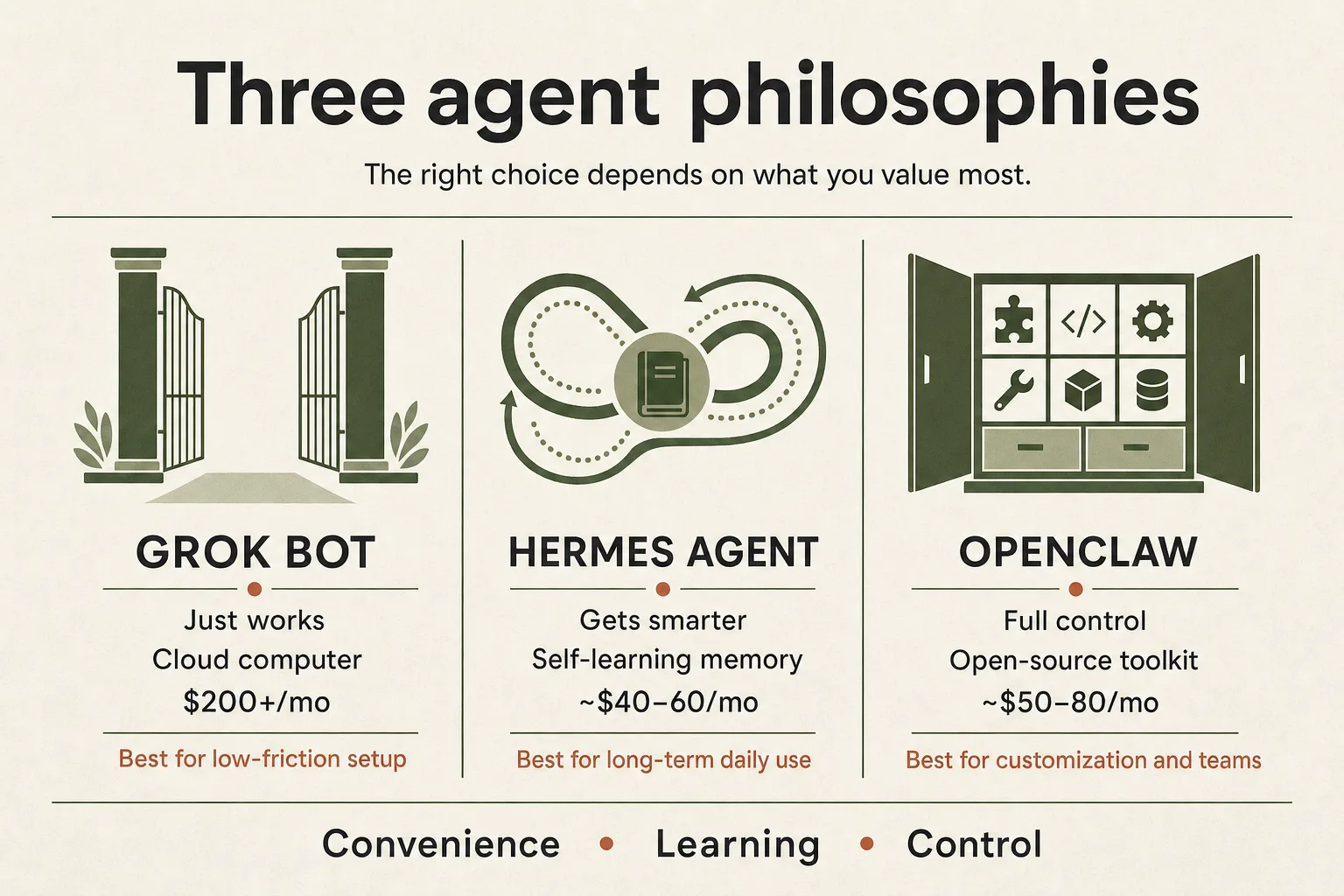
Quick Comparison
| Grok Bot | Hermes Agent | OpenClaw | |
|---|---|---|---|
| What it is | Cloud agent platform with VM | Self-learning personal agent | Open-source agent control plane |
| Launched | August 2026 | February 2026 | November 2025 |
| Open source | No | Yes | Yes |
| Cloud computer | Yes (persistent Linux VM) | No (runs on your VPS) | No (runs on your VPS) |
| Multi-agent | Yes (built-in, named agents) | Yes (sub-agents, automatic) | Yes (multi-node, multi-gateway) |
| Self-learning | Memory layers (user/agent/project) | Yes (reflective phase, auto-skills) | Manual (install from ClawHub) |
| Skill ecosystem | Cursor skills + plugins | Auto-generated + manual import | ClawHub marketplace (5,400+) |
| Triggers/Routines | Slack, Git, Linear, Sentry, PagerDuty | Scheduled jobs, webhooks | Full automation engine |
| Mobile app | Yes (iOS, synced) | No | No |
| Pricing | $200+/month (subscription) | Free (self-hosted) + API costs | Free (self-hosted) + API costs |
| Model | Grok 4.6 (locked) | Any via OpenRouter | Any (configurable) |
Grok Bot is the only one with a built-in cloud computer and mobile app. But it locks you into Grok 4.6 and a $200/month minimum. Hermes and OpenClaw are free to self-host, let you choose any model, and cost a fraction of the price. You handle infrastructure yourself, though.
Grok Bot
Grok Bot ships as a desktop app (plus iOS) where each agent gets its own identity, memory, and cloud computer. You message agents the way you'd message a coworker. They browse the web, open apps, access file systems, take screenshots on their cloud VM. If an agent hits a login page or CAPTCHA, it hands you the keyboard. You authenticate, hand it back.
The multi-agent setup is where it gets interesting. You create named agents (a content bot, a developer bot, an executive assistant) and they talk to each other. In early demos, a developer agent messaged a content agent to get transcript data, discussed app ideas, and then built an iOS prototype from that conversation. No manual context transfer between conversations.
The real-world use cases are surprisingly practical. Within hours of launch, early users shared workflows like: screening 1,000+ event applicants against an ICP and batch-approving the fits, triaging email twice a day, price-comparing Instacart vs Amazon and placing the grocery order, turning Kindle highlights into Anki cards every morning, and scraping Gmail receipts into a subscription list to cancel forgotten ones. The mobile app means you can text your agent from the gym or update decks from the subway.
Routines work like Zapier triggers. Set them on a schedule or fire on events from Slack, Git, Linear, Sentry, or PagerDuty. The trigger list is limited right now. No email triggers. No calendar. Those will probably come, but they're missing at launch.
The real limitation is model lock-in. You can only use Grok 4.6. No Claude, no GPT-5.6, no open-source models. If you care about model flexibility, that's a dealbreaker.
Pricing: SuperGrok Heavy, Cursor Ultra, or Cursor Teams Premium. All $200/month or more. Community feedback has been blunt about this. $200/month is a lot to commit before you know whether an agent platform fits your workflow, especially when Claude desktop handles basic email and scheduling for $20.
Hermes Agent
Hermes Agent, built by Nous Research, takes the opposite approach. Instead of giving you a team of agents, it gives you one agent that improves every time it runs.
The core mechanic is the reflective phase. After finishing a task, Hermes reviews what it did, writes a reusable skill file (a plain markdown instruction manual), and stores it. Next time a similar task comes up, it loads the skill instead of rediscovering the workflow from scratch.
In side-by-side tests published on YouTube, when both Hermes and OpenClaw received a seven-step video research workflow, Hermes auto-created a skill after the first run. When asked to repeat the task in a new conversation, Hermes loaded the skill and executed immediately. OpenClaw had to search through memory, took longer, and produced a less reliable result.
This compounds over time. The curator process runs in the background, moving skills between active, stale, and archived states based on usage. Old skills get cleaned up so context doesn't bloat. Think of it as an assistant who quietly gets better at their job without you having to retrain them.
Memory is the other advantage. Hermes optimizes memory recall speed and can search through more stored context than OpenClaw. It's faster at detecting when to write to memory and better at pulling up relevant context in future sessions.
Setup is the downside. You need a VPS ($5-15/month from providers like Hostinger), you configure it yourself, and the UI isn't as polished as Grok Bot's. It crashes sometimes. Community feedback reflects this: setup is the most common complaint in forum threads and YouTube comments.
Pricing: free to self-host. You pay for the VPS (~$10/month) and API tokens for whatever model you choose through OpenRouter. Heavy daily use might run $30-50/month in API costs depending on your model. Total: $40-65/month, compared to Grok Bot's $200+ minimum.
OpenClaw
OpenClaw launched in late 2025 and became one of the fastest-growing open-source projects on GitHub. It's built around ClawHub, a marketplace of 5,400+ pre-built skills you can browse and install with one click.
Need your agent to manage a GitHub repo, post to social media, check a calendar, or scrape a website? Someone probably built that skill already. Install it and move on. This is OpenClaw's strength over Hermes: you don't wait for the agent to learn. You give it a pre-tested skill file from a community contributor.
The multi-gateway architecture is the other big differentiator. OpenClaw connects to Telegram, Discord, Slack, WhatsApp, a website widget, and Line simultaneously. Each gateway routes to different agents with shared memory. Best option for customer-facing use cases or teams where multiple people interact with the same agent system.
The downside is manual skill management. OpenClaw doesn't auto-create skills the way Hermes does. If you want a custom workflow, you tell the agent to make one, or you write it yourself. It won't figure out patterns on its own. This means higher ongoing token costs because the agent rediscovers workflows instead of loading saved ones.
Security has been a concern. In February 2026, over 40,000 OpenClaw instances were found exposed to the public internet. The issue has been patched, but the large skill ecosystem creates a bigger attack surface than Hermes's self-generated skills. You're importing code written by strangers.
Pricing: same model as Hermes. Free to self-host, $5-15/month for a VPS, plus API token costs. OpenClaw tends to cost more in API tokens over time because it lacks the learning loop that reduces Hermes's token consumption.
How They Actually Differ

Setup
Grok Bot wins here. Open the app, create an agent, start chatting. Plugins connect through conversations. No terminal, no SSH, no YAML files.
Hermes requires a VPS, command-line setup, and manual UI installation (the web interface isn't included by default).
OpenClaw is the most involved. Multi-gateway setup, agent configuration, skill browsing and installation. Worth it for power users. Painful otherwise.
Learning
Hermes wins. The self-improvement loop (reflective phase + curator + optimized memory) is unique. Neither Grok Bot nor OpenClaw auto-creates and manages skills based on usage patterns.
Grok Bot has memory layers (user, agent, project) and persistent context across sessions, but no reflective learning.
OpenClaw saves to memory but doesn't create reusable skill files automatically.
Multi-Agent
Grok Bot wins on user experience. Named agents with personalities, direct inter-agent messaging, visual indicators showing which agent is working. You can watch agents have conversations with each other.
OpenClaw wins on architecture. Multi-node, multi-gateway, multi-agent with shared memory across different communication channels. Better for complex deployments and customer-facing bots.
Hermes handles sub-agents but isn't built for the "team of named agents" paradigm.
Model Flexibility
OpenClaw and Hermes win. Choose any model from any provider. Grok Bot locks you into Grok 4.6.
This matters more than it sounds. If Anthropic releases a better model next month, Hermes and OpenClaw users switch in minutes. Grok Bot users wait for xAI to update.
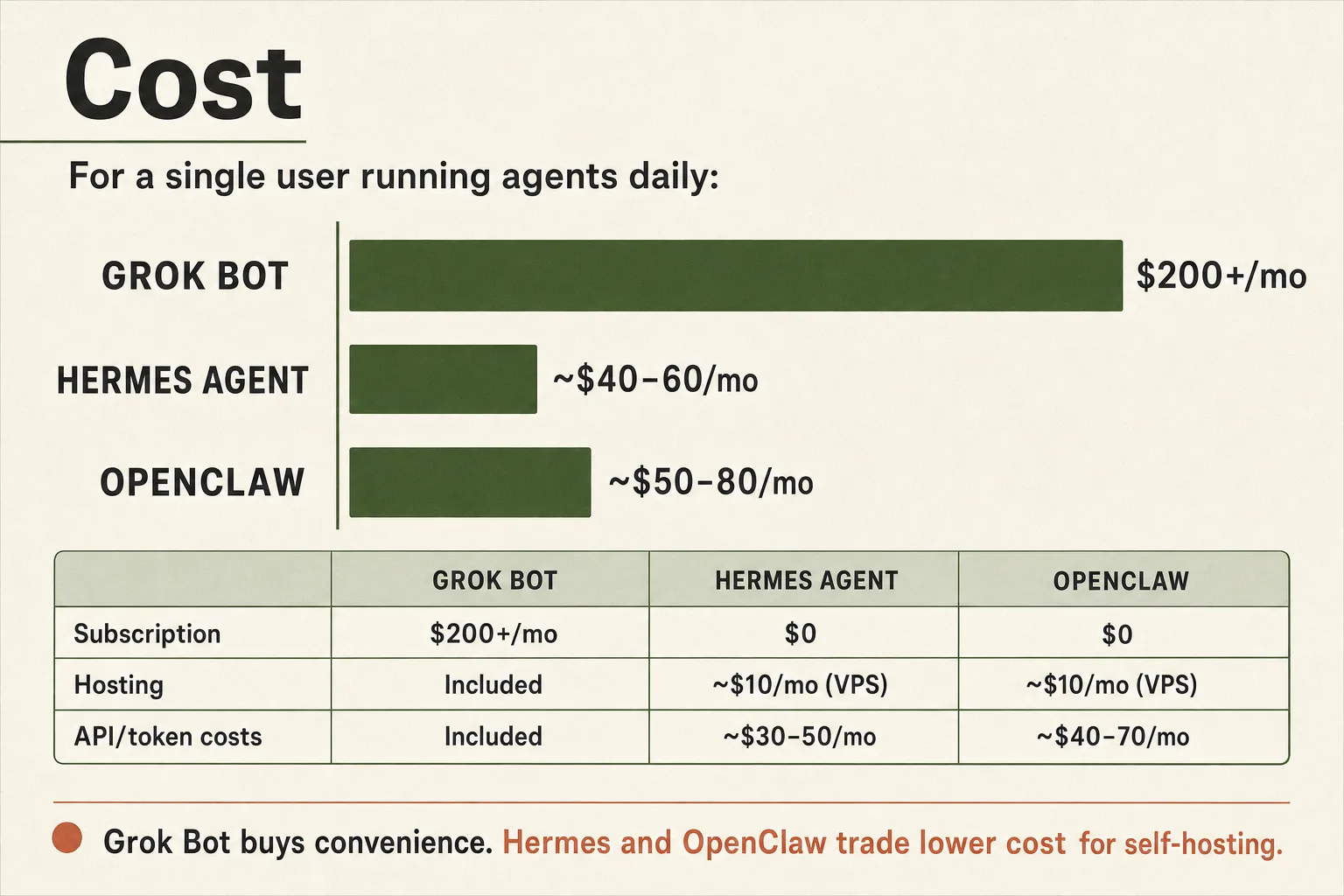
Cost
For a single user running agents daily:
| Grok Bot | Hermes Agent | OpenClaw | |
|---|---|---|---|
| Subscription | $200+/mo | $0 | $0 |
| Hosting | Included | ~$10/mo (VPS) | ~$10/mo (VPS) |
| API/Token costs | Included | ~$30-50/mo | ~$40-70/mo |
| Total | $200+/mo | ~$40-60/mo | ~$50-80/mo |
Hermes gets cheaper over time because skill reuse reduces token consumption. OpenClaw stays roughly flat. Grok Bot stays at $200+ regardless of usage.
Which One to Pick
Grok Bot if you want zero setup friction, you're already on a Cursor Ultra or SuperGrok Heavy plan, and model choice doesn't matter to you. The mobile app and cloud computer are genuine differentiators. If your workflow involves navigating websites (comparing prices, managing orders, filling forms), the built-in VM handles that without browser automation headaches.
Hermes if you plan to use an AI agent regularly for months and want it to get better at your specific tasks. The learning loop is the strongest long-term play. Best for solo users who want a daily-driver agent that adapts. Self-hosting requires some technical comfort, but the cost savings over Grok Bot are 3-4x.
OpenClaw if you need multi-channel support (Telegram + Discord + Slack + web), you want access to thousands of pre-built skills immediately, or you're building customer-facing agent systems. It's the most mature ecosystem, and the most configurable. Best for advanced users and teams.
Can you combine them? Some users pair OpenClaw for coordination (planning, multi-channel routing) and Hermes for execution (getting smarter at the actual tasks). Grok Bot sits in its own ecosystem and doesn't integrate with either. It's an either/or decision with that one.
Compare the AI models powering these agents
See how Grok 4.6, Claude Fable 5, GPT-5.6 Sol, and other models stack up on benchmarks, pricing, and speed.
FAQ
How much does Grok Bot cost?
$200/month minimum. You need a SuperGrok Heavy, Cursor Ultra, or Cursor Teams Premium subscription. There's no free tier and no cheaper plan yet.
Is Grok Bot the same as Grok the chatbot?
No. Grok Bot is a separate product launched August 11, 2026. It's an agent platform with cloud computers, multi-agent communication, and automation routines. Grok (the chatbot) is xAI's conversational AI accessible through X. Different products, different purposes.
Is Hermes Agent better than OpenClaw?
For most individual users, yes. Hermes's self-learning loop reduces costs over time and produces more reliable results on repeated tasks. In published side-by-side comparisons, Hermes automatically created reusable skills after one session while OpenClaw had to rediscover the workflow each time. OpenClaw is better for multi-channel deployments and teams that need pre-built integrations from a marketplace.
Can I use GPT-5.6 or Claude with Grok Bot?
No. Grok Bot only runs Grok 4.6. You cannot switch models. Hermes and OpenClaw both support any model through OpenRouter or direct API configuration.
Which AI agent is best for beginners?
Grok Bot has the simplest setup (just open the app), but costs $200+/month. Hermes on a managed VPS (like Hostinger's one-click deploy) is the best balance of simplicity and cost at ~$40-60/month total.
Are these AI agents safe to use?
All three require trust with your data. Grok Bot runs in xAI's cloud with permission controls and a review agent that checks actions against allow/block lists. Hermes runs on your own VPS, so you control the attack surface. OpenClaw had a security incident in February 2026 (40,000+ exposed instances) but has since patched the vulnerability. Don't give any agent access to accounts you can't afford to have compromised.
Sources: Grok Bot by xAI, Hermes Agent by Nous Research, OpenClaw open-source project. Pricing from official documentation and API pages. Community feedback from X, Reddit, and YouTube comparison videos. For AI coding agents (Claude Code vs Codex), see our separate comparison. Compare the underlying models on the Benchmark Dashboard or find the right model for your use case with the Model Selector.

